You are here:Home » Blog » Top 15 Force Sensor Manufacturers for Buyers in Germany 2026
Top 15 Force Sensor Manufacturers for Buyers in Germany 2026
Views: 0 Author: Site Editor Publish Time: 2026-11-06 Origin: Site
For dynamic force testing, start with HBK or Kistler. For a compact fixture, compare burster, Inelta, or FIBOS. ME-Meßsysteme is a candidate when a robot wrist or test rig needs to measure force and torque across multiple axes. The full shortlist also covers press monitoring, load pins, web tension, and industrial weighing.
This shortlist includes manufacturers with German operations and an overseas manufacturer that accepts direct inquiries. The order is editorial, based on product relevance, breadth of applications, and available technical documentation. Confirm the orderable model and who will handle delivery, calibration, and support in Germany before buying.
Top 15 Force Sensor Manufacturers for Buyers in Germany
1. HBK (HBM) — Strain Gauge and Piezoelectric Force Transducers
HBK's force measurement range includes strain gauge and piezoelectric transducers for industrial tests and production monitoring. Buyers working with older equipment may encounter the HBM name on the transducer or its documentation.
· For a compression fixture, compare a model such as the C2 with the space available for the sensor and its loading hardware.
· Match the sensing principle to the event duration and bandwidth you need to capture.
· When replacing an HBM unit, send the complete model suffix and amplifier details to identify the corresponding configuration.
2. Kistler — Piezoelectric Force Sensors for Dynamic Testing
Kistler is headquartered in Switzerland and has a German operation in Sindelfingen. Its piezoelectric force sensors are relevant to impact testing, fast changes in force, and production processes such as press fitting.
· Choose the sensor and charge amplifier together for charge-output models.
· For a force washer, check the specified preload and the stiffness of the assembled fixture.
· If the measurement includes a hold period, ask how much signal drift to expect over that interval with the proposed amplifier settings.
3. WIKA (tecsis) — Industrial Force Transducers and Load Pins
WIKA's force portfolio incorporates tecsis products and includes tension and compression transducers, load pins, and other industrial designs. It is a candidate when the sensor must fit into an existing machine or lifting assembly.
· Compare load pins and conventional transducers according to where the force passes through the machine.
· For a replacement pin, supply the drawing with bearing spans, diameters, and the direction of loading.
· Specify the electrical output and any project-specific documentation for the exact model on the quote.
4. burster — Miniature Tension and Compression Force Sensors
burster's 8431 and 8432 families illustrate its miniature tension and compression offering. These transducers are candidates for compact test fixtures that need to measure along the sensor axis.
· Compare the available ranges and mechanical overload options for the specific variant.
· Check that the linkage applies force through the threaded axis throughout the stroke.
· If the test stand uses TEDS, confirm compatibility with the amplifier and the configuration being quoted.
5. GTM — Precision Force Transducers for Testing and Calibration
GTM develops force transducers and calibration systems. Its Series K includes tension and compression designs for applications such as materials testing, structural tests, and industrial process monitoring.
· Compare the threaded and flange mounting options against the load introduction shown on the fixture drawing.
· For cyclic testing, give the supplier the expected force amplitude, cycle count, and loading profile.
· When requesting calibration, specify the force direction, range, and whether the readout should be included.
6. ME-Meßsysteme — Multi-Axis Force and Torque Sensors
ME-Meßsysteme offers three-axis force sensors and K6D sensors that measure three forces and three moments. These are candidates for robot tooling, multiaxial test fixtures, and research rigs that need to separate load components.
· Estimate force and moment at the sensor face using the actual tool offset.
· Check the permissible combined loads and the expected cross-talk between channels.
· Confirm the calibration matrix, axis conventions, and compatible electronics before designing the fixture.
7. Lorenz Messtechnik — Tension and Compression Force Transducers
Lorenz Messtechnik supplies force transducers for machine monitoring and test stands. Its range includes the K-25 S-beam for tension and compression applications.
· Compare rod ends, adapters, and installation height in the fully assembled fixture.
· Ask which variants support the wiring arrangement and environmental protection the machine requires.
· If replacing an older transducer, confirm the sensitivity and available overload protection for the proposed variant.
8. A.S.T. — Force Transducers for Presses and Test Machines
A.S.T. offers transducers for pressing and joining, ring-shaped sensors, and tension and compression designs for testing machines. Its range covers several ways of introducing force into an existing fixture.
· Consider a ring design when the installation needs a through-hole and the load can be applied through the specified faces.
· For a test machine, check how the proposed adapters keep side loads and bending moments within the sensor's limits.
· If the control system calls for CANopen, verify the interface on the specific transducer and compare it with the controller's requirements.
9. Inelta Sensorsysteme — Compact and Miniature Force Transducers
Inelta offers compact sensors such as the FS09 for tension and compression and the FS12 miniature force sensor. The drawings help narrow down candidates for a small machine fixture or a laboratory rig with limited travel.
· Check the installed envelope, including threads, adapters, and cable bend clearance.
· Select the sensor by load direction and by the smallest force change the system must resolve.
· Compare the bridge or conditioned output for the exact variant with the available input hardware.
10. FIBOS — Miniature Load Cells and Multi-Axis Force Sensors
FIBOS is a force sensor manufacturer based in Changzhou, China, and accepts direct inquiries. Its range includes miniature button force sensors and multi-axis force sensors. The FA102 is a compression button design for fixtures where installation space is limited.
· For the FA102, use the drawing to position the loading button and check that the surrounding sensor face remains clear of the applied load.
· For three-axis force measurement, share the expected loads in each direction and any moments introduced by the fixture.
· For delivery to Germany, ask for written confirmation of the ship-from location, delivery terms, calibration paperwork, and service route.
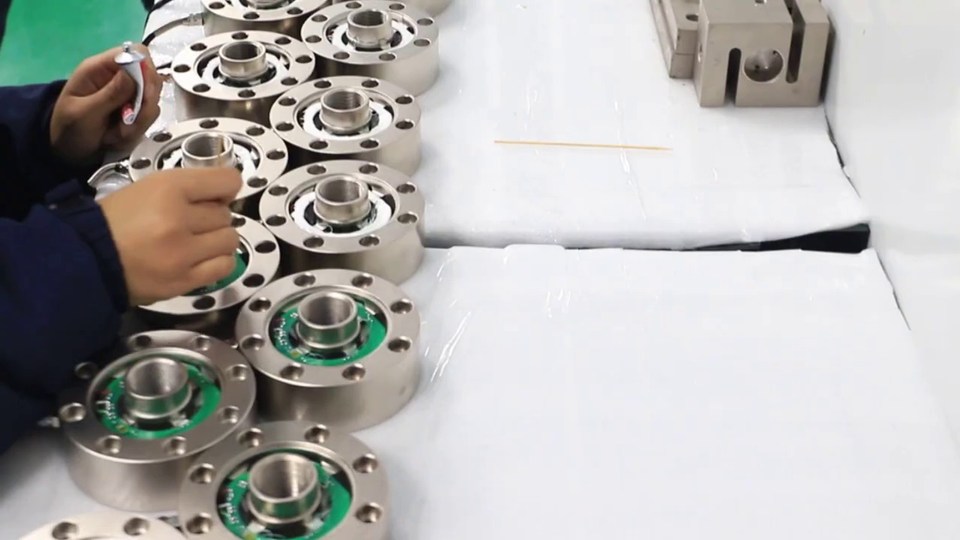
Adhesive application on a force sensor at a FIBOS workstation.
11. HAEHNE — Web Tension and Roller Force Sensors
HAEHNE develops sensors and electronics for web tension measurement. Its range includes radial sensors, measuring bearings, and complete measuring rollers for machinery handling materials such as film, paper, or metal strip.
· Use the web path and wrap angle to work out the resultant force on the roller.
· Include roller weight, mounting orientation, and acceleration when specifying the load on each sensor.
· Check the amplifier output and control response against the existing tension controller.
12. HKM-Messtechnik — Shear Force Transducers and OEM Sensor Systems
HKM-Messtechnik offers standard shear force transducers, tension and compression sensors, and measurement systems that combine the sensor with signal conditioning. It is relevant when an OEM is integrating force measurement into an existing machine structure.
· For a shear force transducer, supply the intended loading diagram and the dimensions of the mating parts.
· Decide whether the equipment needs a bridge signal or a conditioned output that connects to the control system.
· For a tailored assembly, define which parts and electronics will be included in system calibration.
13. VELOMAT — Custom Load Pins and Load Links
VELOMAT develops force measurement assemblies that include load pins and load links. Its products are relevant when an existing joint or pin is the natural place to measure force.
· Send the original drawing, actual bearing positions, and the service load cases.
· Check the cable exit, connector access, and how the pin will be located against rotation.
· Specify whether the quote should include the sensor, electronics, cabling, and calibration as one measurement chain.
14. Core Sensing — Force and Torque Sensors Integrated into Machine Components
Core Sensing's coreIN approach integrates strain-based sensing into components such as hollow shafts. This is a candidate for projects that need to measure loads within a machine component, including rotating assemblies.
· Identify the component and which forces, moments, or torque the project needs to measure.
· For a rotating part, discuss power, data transmission, and usable bandwidth at operating speed.
· Agree on how the completed component will be calibrated after sensor integration.
15. BOSCHE — Industrial Weighing Load Cells and Custom Sensors
BOSCHE offers strain gauge load cells for industrial weighing and develops custom sensors, including miniature force transducers and load pins. Its catalog covers both weighing installations and force measurement components.
· Match the load cell geometry to the structure, such as a platform, hopper, or suspended load.
· Account for tare weight and uneven load distribution before sizing cells for a multi-point weighing installation.
· If the project has a legal-for-trade requirement, ask which approvals cover the proposed configuration and the complete weighing system.
Which Force Sensor Fits Your Application?
· Press and Assembly Monitoring
Start with the feature that separates a good assembly from a bad one. For an insertion process, that might be the force peak at engagement, the slope over a section of travel, or the seating force at a defined position. Capture force and displacement on a common time base. Size the sensor for normal and abnormal loads, then verify the signal on the assembled press with representative parts.
· Low-Force and Dynamic Testing
For a low-force bench test, specify the smallest change you need to resolve and check the noise with the actual fixture, amplifier, and acquisition settings. For an impact or fast transient, estimate the rise time and verify the bandwidth of the mounted sensor, fixture, and electronics together. The sensor's published natural frequency is one input to that check.
· Multi-Axis Force and Torque Measurement for Robotics
Use a three-axis sensor when the project needs the force vector and a six-axis sensor when it also needs moments about all three axes. Include tool weight, acceleration, and offsets in the load case. A 100 N force acting perpendicular to a 150 mm offset creates a 15 N·m moment at the sensor. Compare both values with the manufacturer's combined-load limits.
· Web Tension, Load Pins, and Industrial Weighing
For web tension, start with the roller geometry and the direction of the resultant force. For a load pin, identify the bearing and shear locations on the joint drawing. For weighing, include the dead load and the most uneven credible distribution. These details determine the load each transducer actually sees.
How to Check Whether a Replacement Force Sensor Will Fit
· Match the Mounting Dimensions, Load Path, and Force Direction
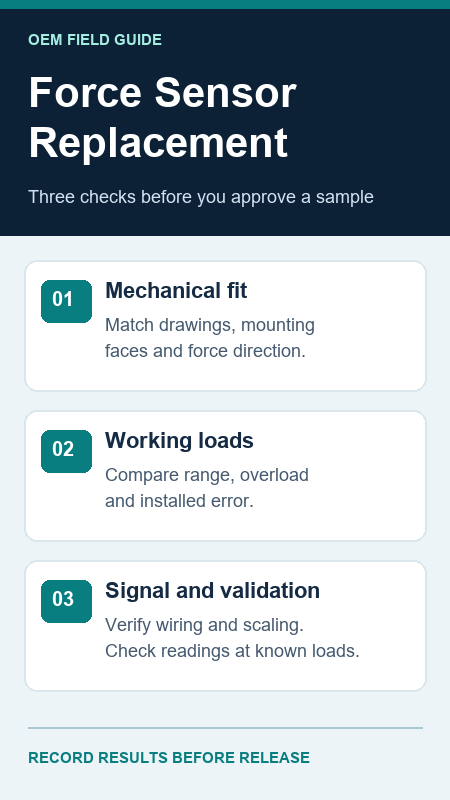
Find the old part number, including any suffix, and place its drawing next to the proposed replacement drawing. Compare installed height, thread pitch, bolt pattern, and cable clearance.
Trace the load through the fixture. Check the contact faces and whether the replacement measures tension, compression, or both as required.
If an adapter is needed, check the assembled height and alignment with the adapter in place. Trial-fit the sensor before approving the replacement.
· Check the Rated Load, Overload Limits, and Measurement Error
Compare the actual working and peak forces with the proposed sensor's rated force and safe overload. For repeated loading, check fatigue data against the expected amplitude and cycle count.
Convert each full-scale error term to force at the proposed range. For example, 0.1% of a 1 kN full scale is 1 N for that term.
Compare hysteresis, repeatability, temperature effects, and installed noise with the process tolerance. Set an acceptance limit for the installed measurement before the sample test.
· Verify the Output, Excitation, and PLC or DAQ Compatibility
Record the old sensor's output type, sensitivity, excitation, pinout, and bridge wiring. Check the replacement against the amplifier or input module. A raw mV/V bridge signal and a conditioned 4–20 mA output require different input hardware.
Set the scaling for the new sensor in the amplifier, PLC, or data acquisition system, wherever the signal is converted to engineering units.
After installation, check zero and polarity. Apply known loads at several points across the working range and record whether the readings meet the acceptance limit.
Check fit and load limits, then verify the installed readings against known loads.
What to Verify Before Ordering Force Sensors in Germany
· Request Drawings, Datasheets, and Calibration Records
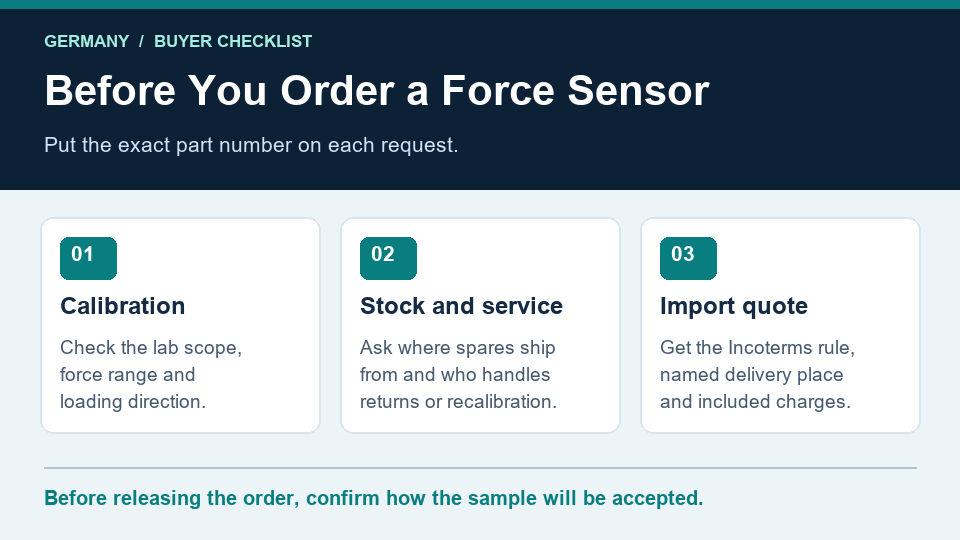
Request the current drawing and datasheet for the exact order code. If the project requires accredited force calibration, ask for the proposed laboratory and its scope. For a DAkkS-accredited lab, use the DAkkS database to check its current status and scope. Compare the scope with the required force range and method, then confirm loading direction and uncertainty with the lab.
· Confirm the Sales Channel, Lead Time, and Support
Ask where the exact part number ships from, whether spare units are stocked in Germany or elsewhere in the EU, and where returns and recalibration are handled. Get separate lead times for a sample, a production lot, and a replacement unit.
For a shipment from outside the EU, ask the supplier to quote the Incoterms® rule and named delivery place, such as DAP or DDP at your German site. Confirm who handles import clearance and which charges are included in the quote.
· Define Sample Acceptance Criteria and RFQ Requirements
Send the same requirements to each manufacturer so the quotes cover comparable configurations.
· Force direction, working and peak loads, cycle profile, and the smallest change you need to resolve.
· Installation drawing, available space, mounting hardware, and environmental conditions.
· Required excitation, output, connector, and PLC or DAQ input.
· Calibration records, sample and production quantities, and delivery location.
· Sample acceptance criteria for mechanical fit, zero stability, repeatability, and agreement at known loads.
Ask the supplier to confirm calibration scope, spare stock and service routes, and quoted delivery terms.
FAQs About Sourcing Force Sensors in Germany
1. What Is the Difference Between a Force Sensor and a Weighing Load Cell?
A weighing load cell measures the force applied by a load so a weighing system can indicate mass. Force sensors also include devices used for tasks such as measuring insertion force, tension, and impact. Catalog terminology overlaps. Check whether the specification addresses your load direction, mounting arrangement, and how the result will be used.
2. When Should I Choose a Piezoelectric Force Sensor Over a Strain Gauge Sensor?
Consider a piezoelectric sensor for fast force changes such as impacts and short assembly events. For sustained loads or long hold periods, a strain gauge transducer is often the starting point. For quasi-static piezoelectric measurements, verify the expected drift and charge amplifier time constant over the actual measurement window.
3. Can I Reuse My Existing Amplifier With a Replacement Load Cell?
Yes, if the amplifier supports the replacement cell's output type, excitation, bridge resistance, sensitivity, and wiring. Confirm the new zero and span settings, then verify the reading with known loads after installation. If the replacement has a different output type, check which input module or conditioner it requires.
4. When Should I Request ISO 376 Calibration for a Force Transducer?
Request ISO 376 calibration when your quality procedure or contract calls for a force-proving instrument used to verify a uniaxial testing machine under static loading. Confirm the required class, range, and loading direction with the laboratory. For a production sensor or dynamic test, specify the calibration and verification requirements for that measurement task.
5. When Does an OEM Project Need a Custom Force Sensor?
Request a custom design review when the load path, mounting envelope, combined loads, environment, or electrical interface cannot be accommodated by a suitable catalog part. Send the assembly drawing and the operating load cases. Agree on how a prototype will be accepted and what mechanical, electrical, or calibration changes must be documented before series production.