You are here:Home » Blog » Solid-State Batteries: Where Force Measurement Matters
Solid-State Batteries: Where Force Measurement Matters
Views: 0 Author: Site Editor Publish Time: 2026-10-26 Origin: Site
Clamping force and isostatic pressure are related to different measurement tasks in solid-state battery manufacturing.
Solid-state battery manufacturing repeatedly comes back to one word: pressure. But a press applying a mechanical load and an isostatic chamber applying fluid pressure need different measurements. One is force, typically expressed in kN; the other is pressure, expressed in MPa.
1. Clamping Force: Making Solid Interfaces Meet
Liquid electrolytes can wet the pores in electrodes and separators. In all-solid-state cells, maintaining contact between solid layers is more difficult. Appropriate compression can help improve interfacial contact, but the required load depends on the materials, cell design, and manufacturing step.
Roll pressing, hot pressing, and formation fixtures all involve mechanical loads. In June 2026, equipment supplier Lyric Robot reported a formation and grading system with an adjustable fixture load of 1–200 metric tons-force and control accuracy of ±1% of reading. These are equipment-level figures, illustrating the scale of the control task.
Measuring total force is the starting point. Average contact pressure also depends on the loaded area, and local uniformity depends on the fixture and cell stack. A repeatable force reading matters, but it cannot establish uniform pressure across every layer by itself.
2. Isostatic Pressing: Following a Pressure Profile
Some manufacturing routes use warm isostatic pressing to densify the cell stack. A pressurized medium applies pressure around the workpiece. This is a chamber-pressure measurement task, rather than a direct measurement of the press or fixture load.
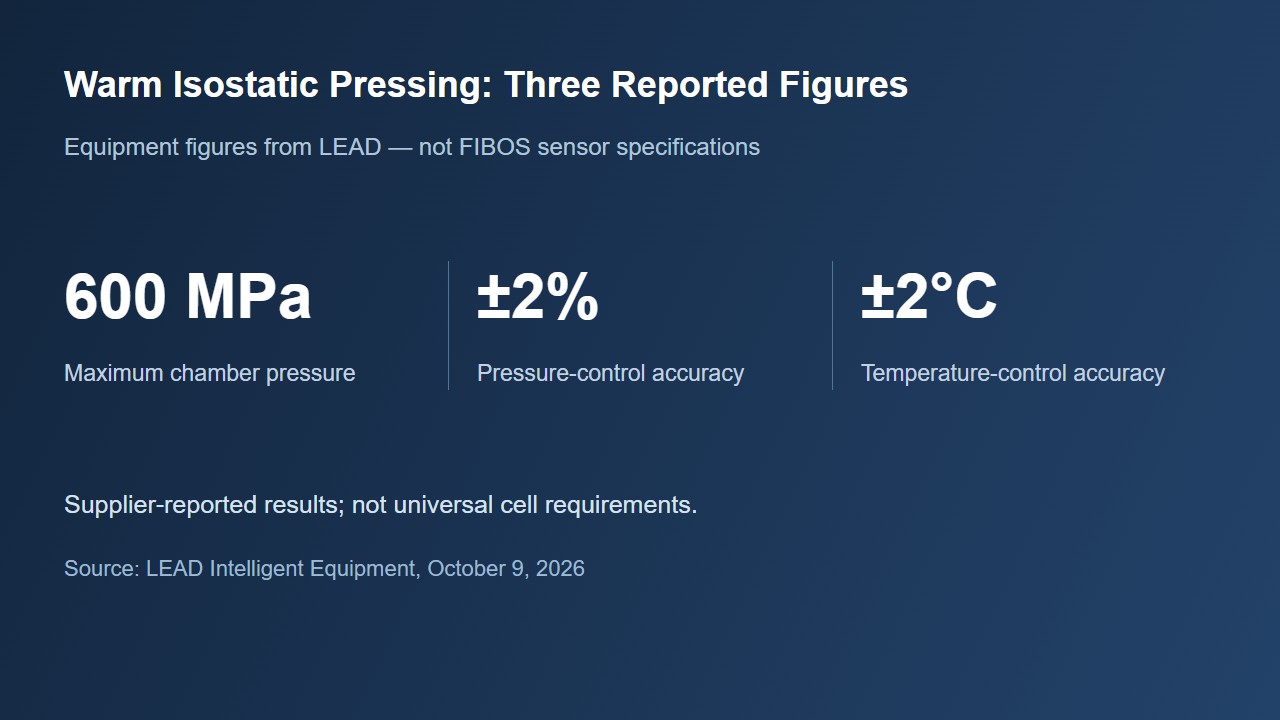
LEAD Intelligent Equipment reported a warm isostatic press operating at up to 600 MPa in October 2026, with pressure-control accuracy of ±2% and temperature-control accuracy of ±2°C. These are supplier-reported results for that equipment, rather than universal requirements for solid-state cells.
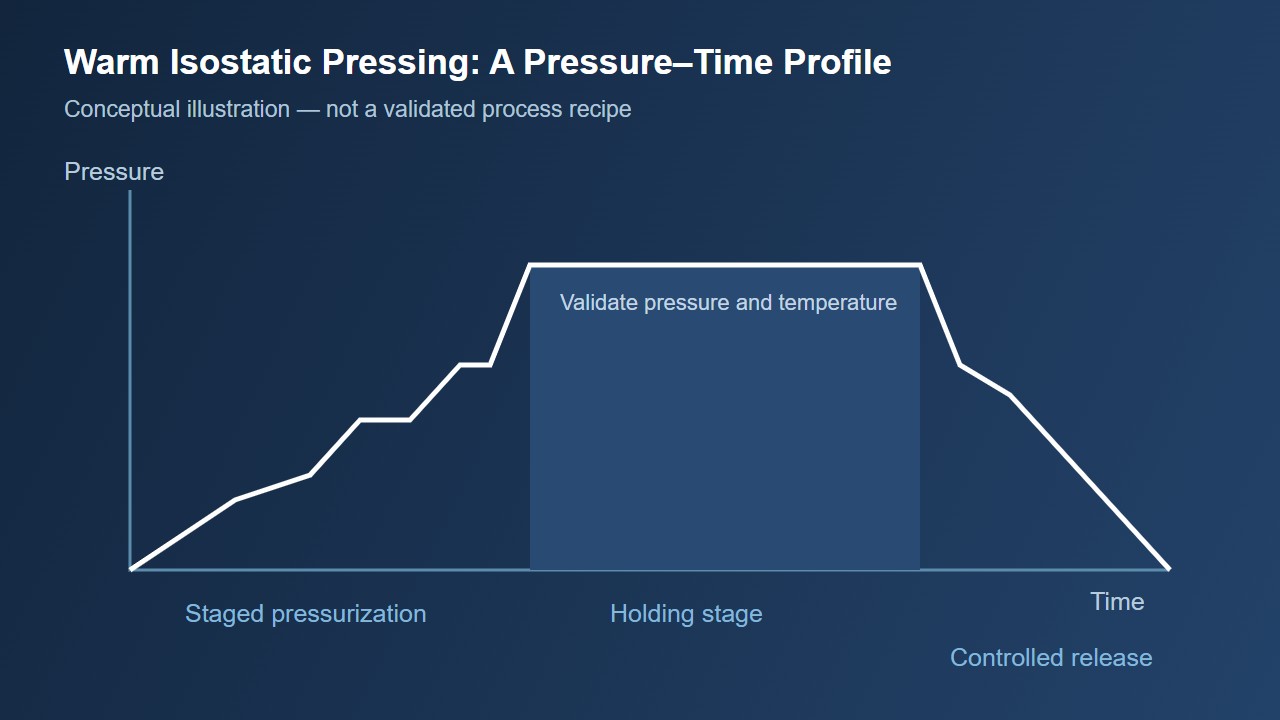
A conceptual pressure–time profile with staged pressurization, holding, and decompression. The actual recipe requires process validation.
Different layers respond differently to pressure and temperature. Staged pressurization, holding, and decompression can be evaluated to manage deformation and stress. The task is to follow a validated profile—not simply reach a peak number.
Selected supplier-reported figures for LEAD’s warm isostatic pressing equipment, published October 9, 2026.
3. Where FIBOS FA410 Fits: Measuring Mechanical Force
The distinction points to two measurement paths: pressure transducers for the chamber medium, and load cells for mechanical forces in presses and fixtures. FIBOS FA410 belongs to the force-measurement path.
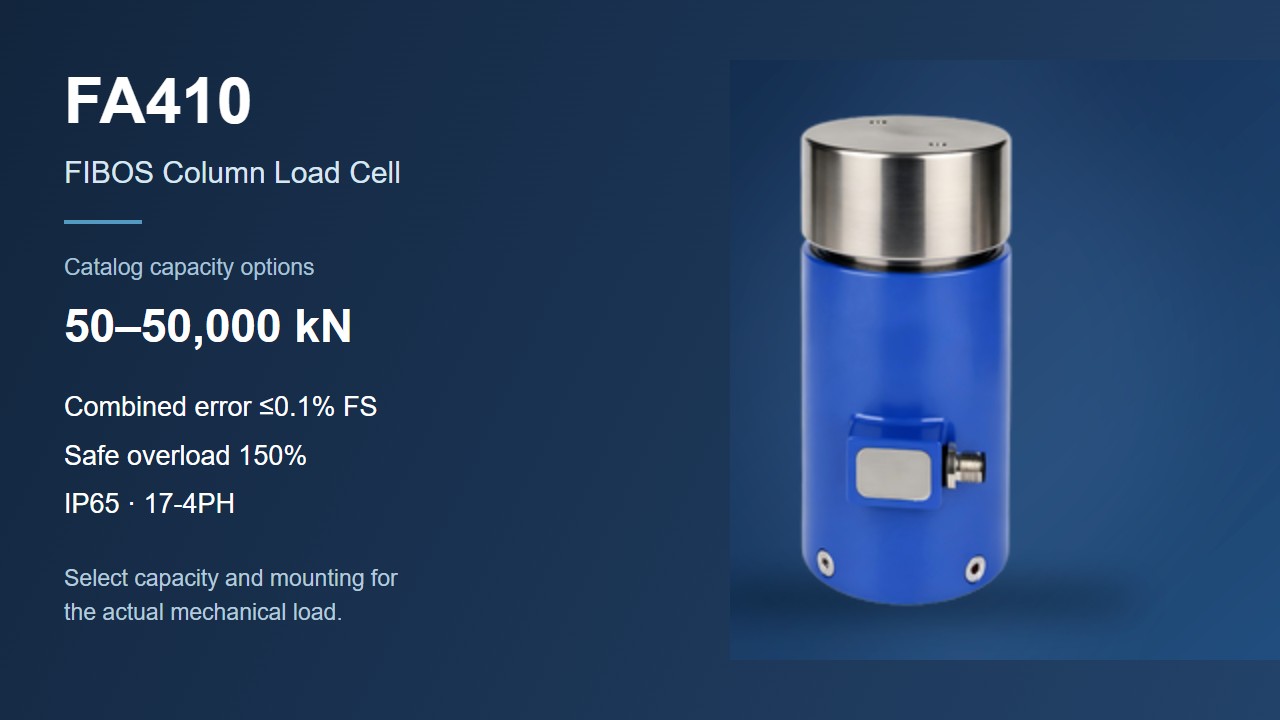
The FA410 column load cell has catalog capacity options from 50 to 50,000 kN, combined error of ≤0.1% FS, 150% safe overload, IP65 protection, and a 17-4PH spring element. The capacity and mounting arrangement must match the equipment’s actual load path; the published range covers different capacity versions.
FIBOS FA410 column load cell. Select capacity and mounting for the actual force-measurement task.
FA410 is not a sensor for measuring 600 MPa chamber pressure. Its role is to turn mechanical load into a measurable signal. Combined with suitable acquisition and control, that signal can show how force rises, holds, and releases—bringing the discussion from how hard a process presses to how consistently it applies force.