You are here:Home » Blog » Top 10 Load Cell Manufacturers in China in 2026 for OEM and Industrial Buyers
Top 10 Load Cell Manufacturers in China in 2026 for OEM and Industrial Buyers
Views: 0 Author: Site Editor Publish Time: 2026-11-16 Origin: Site
The right load cell manufacturer depends on what your machine needs to measure. For a platform scale or a hopper, start with the weighing structure, how the load is distributed, and any legal-for-trade requirements. For a press, actuator, or test fixture, start with the force direction, peak load, usable mounting space, and the input your controller can read.
How We Selected These Load Cell Manufacturers
We selected manufacturers with publicly documented load cell products for weighing or force measurement. We reviewed product families and available technical information, then identified the applications where each catalog gives buyers a practical starting point. The numbers indicate editorial order. Compare the exact model, drawing revision, documentation, and sample performance for your project.
Top 10 Load Cell Manufacturers in China in 2026
1. ZEMIC
ZEMIC's catalog covers single-point, shear beam, dual shear beam, S-type, and compression load cells. The product range gives scale builders a starting point for both single-cell platforms and industrial weighing systems with several support points.
· Platform scales: compare the published platform size and mounting drawing for the single-point model.
· Regulated weighing: request the certificate covering the exact model and capacity.
2. KELI Sensing Technology
KELI supplies weighing sensors and indicators. Its published load cell documentation includes analog beam designs and digital options for industrial weighing, making it relevant when the sensor and indicator must be specified together.
· Industrial scales: compare beam or compression designs against the scale's support geometry.
· Analog assemblies: match bridge output, excitation, and wiring to the indicator.
· Digital assemblies: verify the protocol, addressing, and supported indicator model before ordering.
3. FIBOS Measurement Technology
Based in Changzhou, FIBOS offers load cells for platform weighing, industrial scales, and load monitoring in lifting equipment. Its load cell catalog includes single-point, shear and cantilever beam, bending beam, S-beam, spoke, tension link, column, and load pin designs. Start with the weighing structure and maximum load at each mounting point.
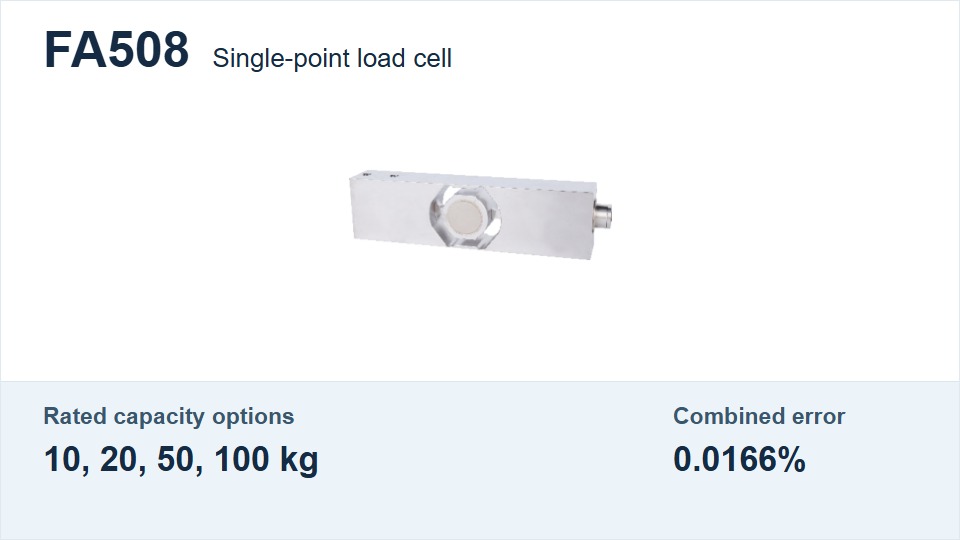
· Platform scales: compare FIBOS Load Cells, starting with the FA508 single-point model. Check platform dimensions and off-center loading.
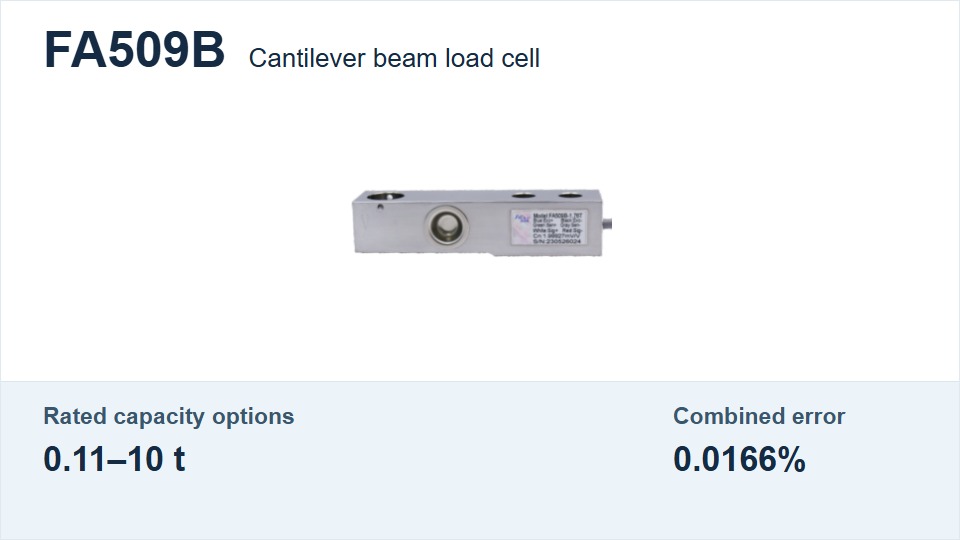
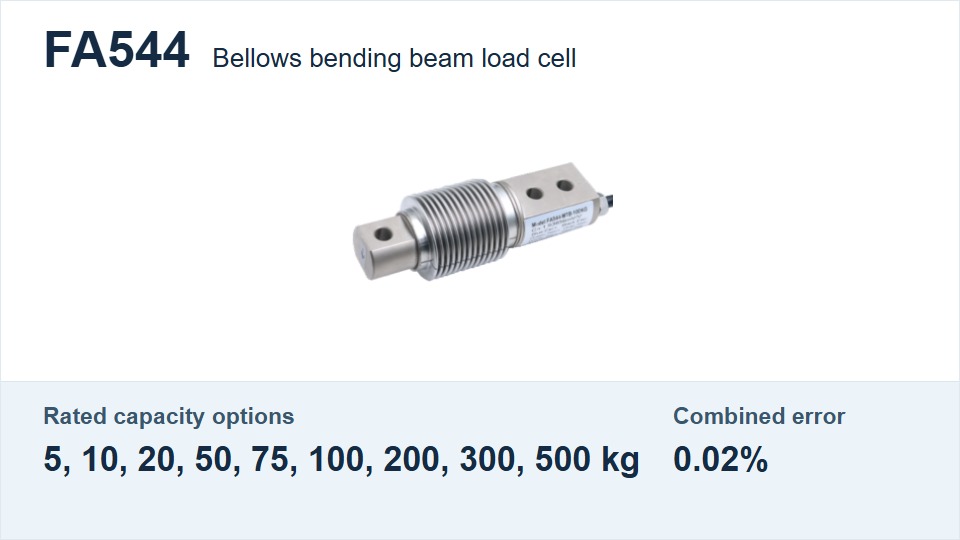
· Industrial weighing: compare the FA509B cantilever beam with the FA544 bellows bending beam. Check the mounting geometry, loading point, and required capacity per support.
· OEM integration: share the mounting drawing, dead load, maximum working load, desired accuracy, and indicator or PLC input for feasibility review.
FA508 single-point load cell. Rated capacity options: 10, 20, 50, or 100 kg. Datasheet combined error: 0.0166%.
Combined error is the load cell specification. For installed weighing accuracy, verify performance with the complete scale, including the mounting hardware and indicator.
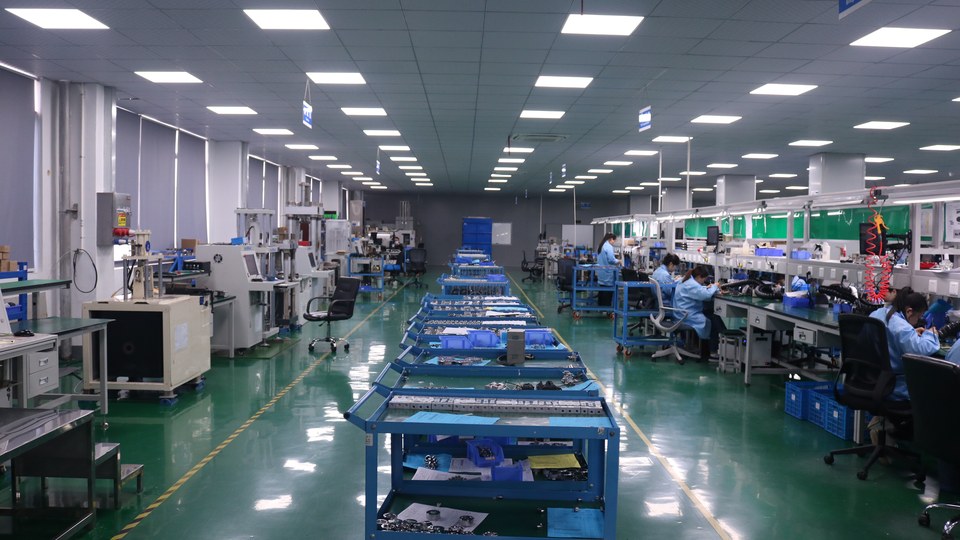
Inside the FIBOS production assembly workshop.
4. MAVIN (Hope Technologic)
MAVIN is the load cell brand produced by Hope Technologic in Xiamen. Its catalog includes single-point, shear beam, and S-type products for commercial weighing and industrial equipment.
· Compact scales: compare low-capacity single-point models and maximum platform dimensions.
· Floor and vessel weighing: compare the beam and the required installation hardware together.
· Certified configurations: check the model suffix and capacity on the applicable certificate.
5. Aerospace Nanyang
Aerospace Nanyang develops and manufactures industrial load cells in Zhejiang. Its focus on industrial weighing makes it a candidate for projects where the support structure, installation hardware, and commissioning procedure drive the design.
· Send a support layout with dead load, working load, and the worst-case load at each support.
· Ask for the load cell and mounting drawings together so the engineering team can check the load path.
· Agree on how the installed system will be calibrated and verified under load.
6. XJCSENSOR
XJCSENSOR offers compression load cells and other force sensors for automation and equipment integration. Its catalog is relevant to machine builders fitting a force sensor into a tool head, inspection station, or test assembly.
· Compare capsule-style compression models where mounting height is limited.
· Share the force cycle and required response so the sensor and acquisition system can be evaluated together.
· Verify the overload rating, cable routing, and output for the quoted configuration.
7. Labirinth Microtest Electronics
Labirinth is a Tianjin manufacturer of load cells, weighing modules, and related components. Its range gives process equipment builders a place to compare a bare sensor with a module that already incorporates mounting hardware.
· Tank or hopper projects: review the module layout with the vessel support arrangement.
· Use the installation drawing to check restraints, clearances, and mounting plate dimensions.
· Confirm which hardware and wiring accessories are included in the quotation.
8. Forsentek
Forsentek's catalog includes miniature strain-gauge load cells and tension and compression transducers. It is a candidate when a test fixture or device has limited space or needs to measure small forces.
· Start with a dimensional drawing and identify the available loading face or threaded interface.
· Check the smallest force you need to resolve using the proposed amplifier and acquisition hardware.
· For compression-only designs, test the effect of contact position and fixture alignment.
9. SAINTBOND
SAINTBOND lists shear beam, S-type, compression column, hollow, and other load cells. This catalog is relevant to industrial projects comparing several ways to introduce load into a sensor.
· Compare shear beam and compression column options against the mounting arrangement.
· For hollow designs, check bore diameter and the load-bearing contact surface.
· Ask for model-specific dimensions, rated load, and output before approving a sample configuration.
10. Ningbo Yubo Sensor
Ningbo Yubo Sensor lists load cells, weighing modules, and weight-control equipment. It is a candidate when the project needs weighing components for a process machine or an automated weight-control system.
· Define whether the quote should cover a sensor, a module, or additional control components.
· Confirm the mounting drawing and signal interface for the exact product configuration.
· Agree on which test results will be supplied with samples and production units.
How to Choose a Load Cell Manufacturer for Your Application
· Match the Load Cell Type to the Application and Load Direction
Use the mechanical load path to narrow the catalog. For a single-point platform, check the supported platform dimensions and off-center load behavior. For a tank, calculate the maximum load at each support with vessel dead weight, uneven filling, and connected piping in mind. For a press or actuator, identify where the force enters the sensor and whether the fixture introduces side load or bending.
· Check Capacity, Accuracy, Mounting, and Signal Compatibility
Specify the normal operating range, peak load, and smallest required measurement. Compare nonlinearity, hysteresis, repeatability, or creep under the conditions relevant to the application. Check drawing dimensions, threads, fasteners, and clearance under load. For an mV/V bridge, verify excitation and amplifier input range. For conditioned or digital outputs, verify supply voltage, input type, and protocol at the controller.
· Verify Calibration Documentation and Any Required Approvals
Ask for a sample calibration report showing the model, serial number, test points, and reference used. Specify any traceability or accreditation requirement in the RFQ. For regulated weighing, verify that the exact model and capacity fall within the applicable certificate and check the separate requirements for the complete weighing instrument in the destination market.
· Validate Samples Before Approving Volume Production
Install the sample in the production fixture with the intended cables, amplifier, and controller. Record zero, output over the working range, repeatability, and zero return after unloading. Add a sustained-load, eccentric-load, or cycle test when the application calls for one. Define pass limits before testing and record the approved part number and drawing revision on the production purchase order.
What to Include in a Load Cell RFQ
Send the same specifications and acceptance criteria to all shortlisted manufacturers so their quotations can be compared line by line.
· Application and loads: explain what you are measuring, normal and peak loads, directions, operating cycle, and target measurement tolerance.
· Mechanical integration: attach a dimensioned drawing or CAD file showing load introduction, interfaces, installation envelope, and cable exit.
· Electrical and environmental requirements: specify excitation or supply, output, connector pinout or digital protocol, temperature, and exposure to water, dust, or cleaning chemicals.
· Documentation and acceptance: list the required drawings, calibration records, approvals, and sample tests. For a replacement, include the old model and suffix, its datasheet, and the existing wiring diagram.
· Order and delivery details: request sample and production prices, tooling charges, minimum quantities, lead times, shipping terms, and the process for returns or recalibration.
Frequently Asked Questions
1. What Is the Difference Between a Weighing Load Cell and a Force Sensor?
Both convert an applied load into a measurable signal. A weighing load cell is selected for a system that reports weight or mass, so platform geometry, load distribution, and sustained loading may drive the choice. A machine force sensor measures tension, compression, or both, typically in newtons. Its loading direction, fixture, and measurement response often drive the choice.
2. When Do I Need an OIML- or NTEP-Certified Load Cell?
Start with the destination market and how the measured weight will be used, especially if it determines a commercial transaction. OIML R 60 addresses metrological requirements for load cells. NTEP provides Certificates of Conformance under the US type evaluation program. Ask for the exact certificate and confirm the requirements for the whole instrument with the relevant authority or compliance team.
3. Can I Replace an Existing Load Cell With a Model From a Chinese Manufacturer?
Yes, if the candidate passes mechanical, electrical, and installed performance checks. Start with the old part number and suffix, datasheet, mounting drawing, and wiring. Compare the load direction, capacity, mounting dimensions, output and excitation, and any approvals. Trial-fit the sample, recalibrate the system, and check readings at representative loads and load positions before accepting the substitution.
4. When Should I Specify a Custom Load Cell for an OEM Project?
Request a feasibility review when standard models cannot meet the available space, interface, load direction, or signal requirements. Share the drawing, loads, expected volumes, and acceptance criteria. Ask which changes affect tooling, delivery, calibration, or requalification and confirm the drawing revision before ordering samples.
5. What Should I Test on a Load Cell Sample Before Placing a Bulk Order?
Check dimensions, wiring, and initial zero, then run repeated measurements at representative loads with the intended acquisition hardware. Measure zero after unloading and confirm the readings meet the acceptance limits. For weighing, add a dwell or off-center check where relevant. For cyclic force measurement, run representative cycles at the planned speed and verify the signal stays within tolerance.