You are here:Home » Blog » Top 20 Load Cell Manufacturers for U.S. Buyers in 2026
Top 20 Load Cell Manufacturers for U.S. Buyers in 2026
Views: 0 Author: Site Editor Publish Time: 2026-11-23 Origin: Site
Start with the job the load cell must do. A platform scale needs a cell rated for its platform size and off-center loading. A tank needs a mounting assembly matched to its support loads. A force test may need a low-profile transducer, a defined calibration range, and enough bandwidth to capture a short event. The same rated capacity can lead to very different choices.
For industrial scales and process weighing, compare Flintec, METTLER TOLEDO, VPG Force Sensors, and FIBOS. For embedded equipment, compare FIBOS, FUTEK, and Transcell against the available space and controller input. For force testing, start with Interface, Honeywell, or Transducer Techniques. The profiles below identify representative products and the applications they serve.
How We Selected These Load Cell Manufacturers
We reviewed manufacturers' published load cell portfolios for relevance to industrial weighing, OEM equipment, replacement work, and force testing. The list is an editorial selection for U.S. projects. It includes manufacturers with U.S. operations and international options that U.S. buyers can evaluate through a local or cross-border purchasing route. The sequence reflects the range of applications covered by the guide.
Top 20 Load Cell Manufacturers for U.S. Projects
1. Interface — Force Measurement and Test Systems
Interface develops load cells and supporting instrumentation for force measurement in industrial and laboratory test systems.
· Key products: LowProfile load cells and force measurement instrumentation.
· Best for: Presses, test stands, and lab fixtures where installation height matters.
· Worth noting: Its Scottsdale, Arizona, site houses both manufacturing and an accredited calibration laboratory.
2. METTLER TOLEDO — Digital Load Cells and Industrial Weigh Modules
METTLER TOLEDO serves industrial weighing projects that specify the sensor, mounting hardware, and terminal together.
· Key products: POWERCELL digital canister load cells and industrial weigh modules.
· Best for: Digital truck scales and tank installations that need dedicated weigh modules.
· Worth noting: POWERCELL sends individual cell readings to a compatible terminal, helping identify a problem at a specific cell.
3. Flintec — Load Cells for Industrial Scales and Process Weighing
Flintec covers both compact platforms and multi-cell industrial weighing systems.
· Key products: PC6 single-point cells in 10–200 kg capacities and RC3 compression cells in 7.5–300 t capacities.
· Best for: Bench and platform scales, process vessels, and heavy industrial weighing.
· Worth noting: The PC6 uses 17-4 PH stainless steel. The RC3 is a single-column compression design.
4. HBK (HBM) — Analog and Digital Load Cells for Weighing Systems
HBK offers analog and digital weighing products under a portfolio that includes HBM load cells.
· Key products: Analog single-point load cells and digital weighing families such as FIT.
· Best for: Packaging, filling, sorting, and checkweighing lines with a defined machine cycle.
· Worth noting: HBK offers digital cells specifically for weighing in motion, alongside cells intended for static platforms.
5. FIBOS Measurement Technology — Industrial Load Cells and Weigh Modules for OEMs
FIBOS Measurement Technology (Changzhou) manufactures industrial load cells and weigh modules, and offers custom options for OEM integration. Its catalog includes strain-gauge weighing cells and electromagnetic force compensation modules for small samples.
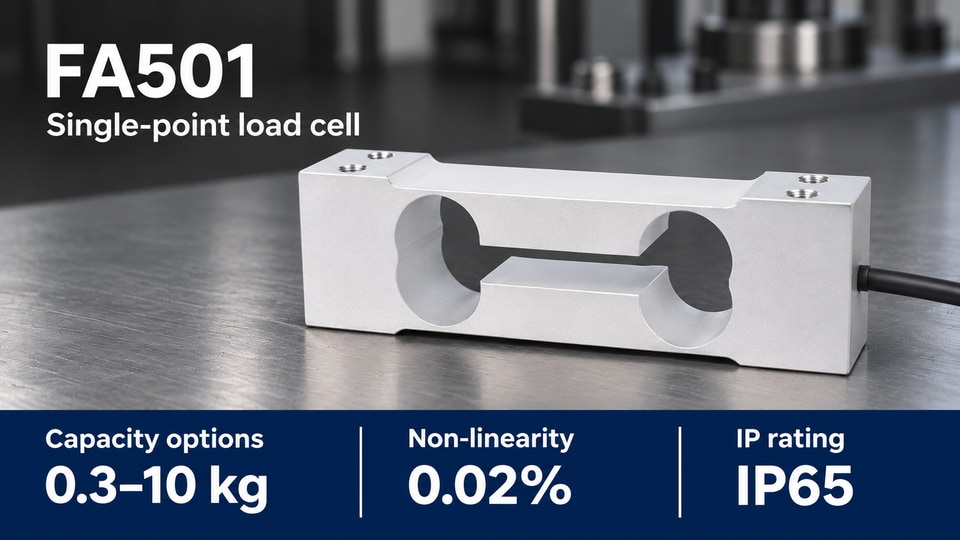
· Key products: FA501 single-point cells in 0.3–10 kg capacities with a maximum platform size of 200 × 200 mm. The FA509A shear beam is made of 17-4 PH stainless steel, rated IP68, and specified at 0.22–4.4 t in the load rating table. FA810 and FA838 weigh modules are rated 2.5–100 t and 50–100 t per module, respectively.
· Best for: Platform scales, tanks, and automated equipment that weighs small doses. The FA-L124 module has a 120 g maximum capacity, a 0.1 mg graduation, and RS-232 and RS-485 communication options.
· Worth noting: The catalog includes amplifiers and weighing indicators, so an equipment team can evaluate the sensor, mount, and readout as part of the same measurement chain.
FIBOS FA501 single-point load cell, product illustration based on the manufacturer's product image. Rated capacity options span 0.3–10 kg. The datasheet lists 0.02% non-linearity and IP65.
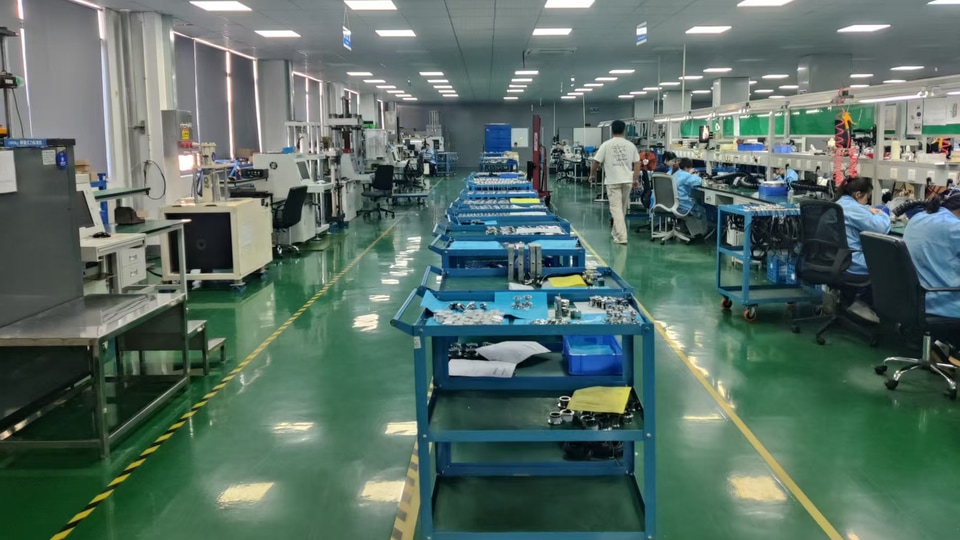
Photo from the FIBOS assembly workshop showing production workstations and parts carts.
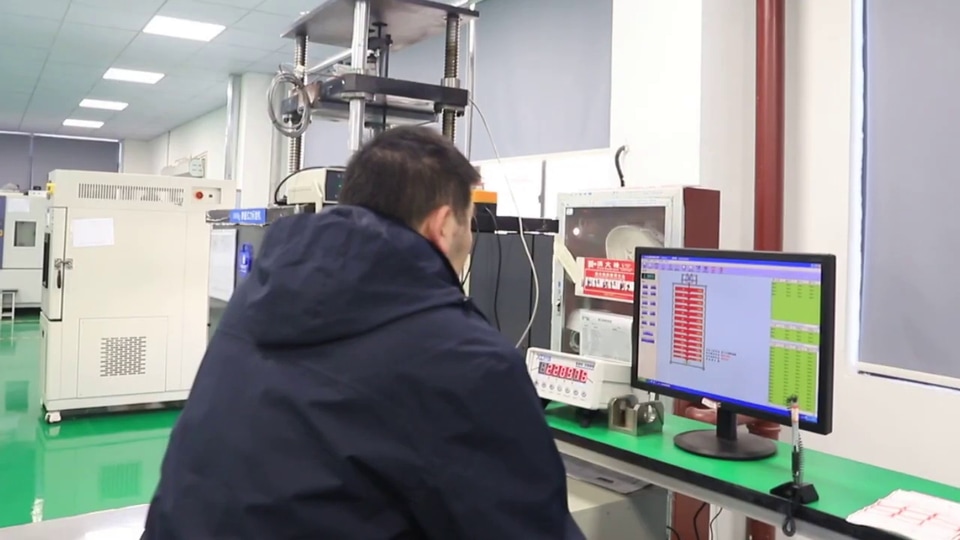
A FIBOS test workstation, shown in a frame from the company's factory video.
6. FUTEK — Miniature and Custom Load Cells for OEM Devices
FUTEK manufactures strain-gauge load cells for measurement tasks where mechanical packaging can drive the design.
· Key products: Load buttons, miniature tension and compression cells, and custom strain-gauge load cells.
· Best for: Compact OEM assemblies, instrumented fixtures, and benchtop devices.
· Worth noting: FUTEK describes an in-house process that includes machining the sensing element and bonding the strain gauges.
7. VPG Force Sensors — Load Cells for Industrial Weighing and Scale Service
VPG Force Sensors brings several long-established weighing brands under one product portfolio.
· Key products: Tedea-Huntleigh single-point cells, Sensortronics beam cells, and Revere and Celtron weighing products.
· Best for: Industrial scales, OEM weighing assemblies, and maintenance of scales with legacy brand markings.
· Worth noting: Its catalogs include selected cross-references between brands that help identify candidates for dimensional and electrical comparison.
8. Rice Lake Weighing Systems — OEM Load Cells and Weighing Components
Rice Lake combines its own weighing products with a catalog that also covers other manufacturers' components.
Strain Measurement Devices builds custom sensors for equipment designs with specific mechanical or electrical requirements.
· Key products: Custom load cells built with sputtered thin-film strain gauges.
· Best for: OEM designs with tight space, unusual loading geometry, or a specific electrical interface.
· Worth noting: SMD describes an in-house manufacturing process after the custom design and tooling are finalized.
20. Emery Winslow Scale Company — Hydrostatic Load Cells for Industrial Scales
Emery Winslow builds industrial weighing systems around hydrostatic load cells.
· Key products: Hydrostatic load cells, hydraulic lines, and pressure-summing assemblies used in its scale systems.
· Best for: Industrial scales in wet or washdown environments where a hydrostatic system is under evaluation.
· Worth noting: The load becomes hydraulic pressure at the cell. A multi-cell system can combine the pressure signals at a summing totalizer.
How to Choose a Load Cell Manufacturer for Your Application
· Platform Scales and Packaging Equipment
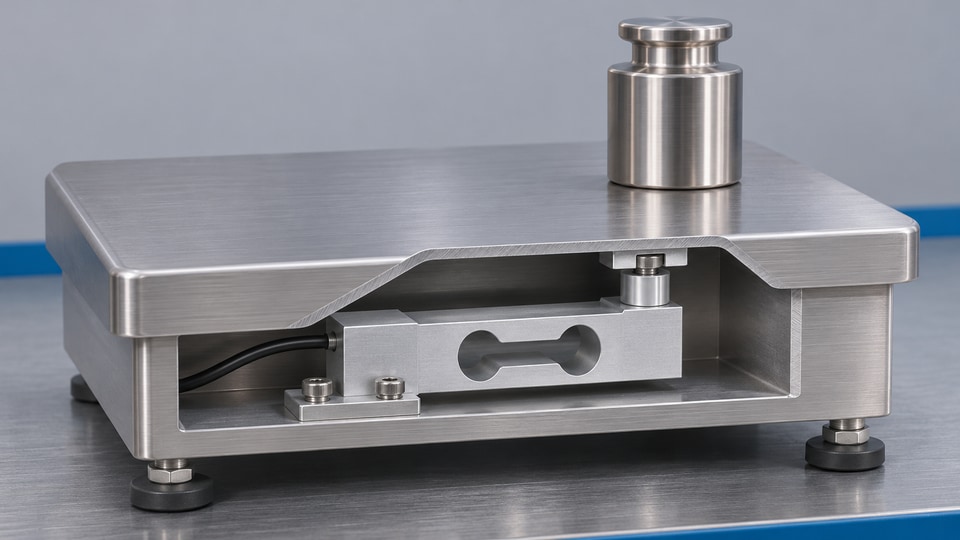
For a compact platform scale, compare the platform dimensions in the cell drawing and test readings with the same load at the center and near the corners. For a filling or checkweighing machine, measure how much time is available between placement and the accept or reject decision. Ask HBK or another supplier with dynamic weighing options for the response of the proposed cell, electronics, and filter settings under your cycle conditions.
Platform-scale illustration. An off-center test load helps check how readings change with load position.
· Tank, Hopper, and Silo Weighing
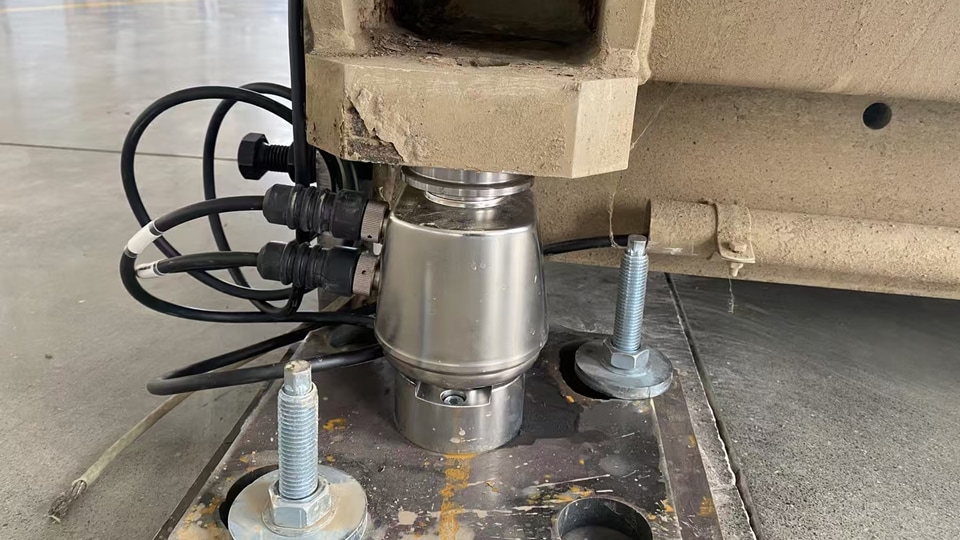
Send the vessel drawing, empty weight, maximum contents, support layout, and pipe connections to the supplier. Check the highest loaded support under filling, agitation, and any other credible load case, then select the cell and mount together. For example, a vessel with 2,000 lb of dead load and 6,000 lb of contents averages 2,000 lb per support across four legs under ideal static load sharing. If structural analysis gives 3,000 lb at one support, use that reaction and the applicable load allowances when selecting its module. Compare mounting arrangements from candidates such as METTLER TOLEDO, FIBOS, Flintec, and LAUMAS.
Field photo showing a cylindrical weighing assembly beneath an equipment support.
· Truck Scales and Heavy-Duty Weighing
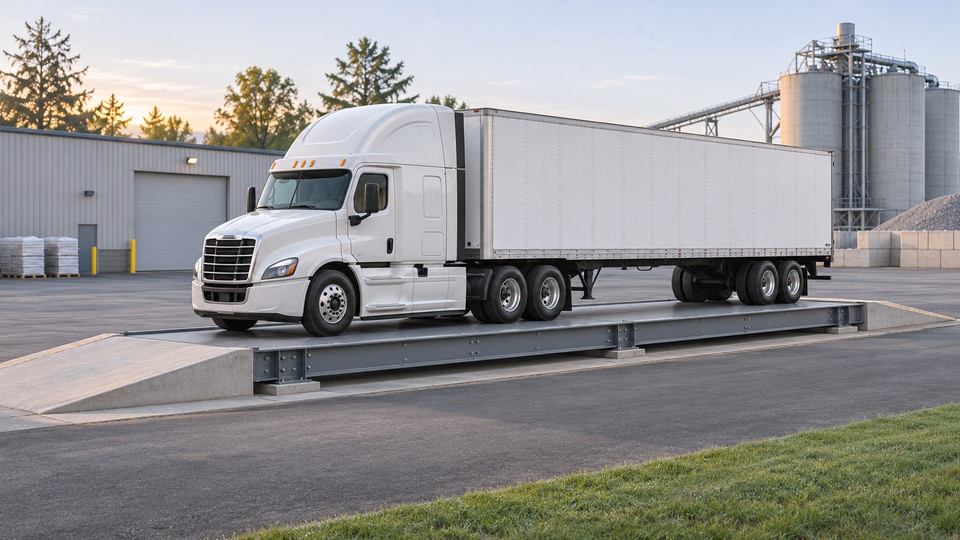
Start with the weighbridge drawing, cell position, receiver hardware, and indicator model. Match the load cell and mount to the scale design, including concentrated loading and site exposure. For a digital system, confirm terminal compatibility and the procedure for assigning a replacement cell. Compare documented options from Cardinal Scale, METTLER TOLEDO, or Avery Weigh-Tronix. For a commercial scale, check the approved configuration before ordering.
Truck weighbridge illustration showing the vehicle on the weighing deck.
· OEM Equipment and Embedded Load Measurement
Send a drawing showing where the force enters, where the sensor is fixed, and where the cable can exit. Compare a standard design with a custom option based on the space available, the expected loads, the required resolution, and production volume. Test with the production fixture, cabling, and controller so sample results reflect the equipment the customer will receive. For small-dose filling or dispensing by weight, an integrated module such as the FIBOS FA-L series is worth comparing. Measure repeatability and settling time with the actual sample, fixture, and machine vibration.
· Force Testing, Automation, and Research
Define the smallest force difference the system must resolve, the maximum force it must survive, and the event duration. For short events, check mechanical response, sensor and conditioner bandwidth, filtering, and acquisition settings as one measurement chain. For slow tests, run repeated loading and unloading with the actual fixture to check zero return, repeatability, and any error introduced by alignment. Research teams can compare FIBOS miniature compression cells, tension and compression transducers, and multi-axis sensors according to the force components the experiment must measure.
What to Verify Before Ordering Load Cells for a U.S. Project
· Capacity, Load Direction, Mounting, and Signal Compatibility
Compare engineering drawings and data sheets for the exact option you will order. Record the load direction, working and peak loads, usable mounting area, temperature range, and exposure to moisture or chemicals. For a strain-gauge output in mV/V, check the instrument's excitation voltage and input range. For digital output, check power, wiring, protocol, and update rate. Write down the units, especially when drawings mix pounds, pounds-force, kilograms, and newtons.
· Calibration Records and NTEP Documentation for Legal-for-Trade Applications
Ask what the calibration report covers, which points and load directions were tested, and whether it identifies the serial number and the instrument used. If accredited calibration is a project requirement, verify that the laboratory's scope covers the method and range. For legal-for-trade weighing, check the scale's NTEP Certificate of Conformance and the configuration it covers. Use the 2026 edition of NIST Handbook 44 and confirm site requirements with the state or local weights and measures authority.
· Shipping Origin, Lead Times, Spare Parts, and Service
Ask for the ship-from location, quotation validity, lead time for the exact part, and the contact for returns or recalibration. For cross-border orders, agree on who handles freight, import clearance, and other charges under the quoted delivery terms. If downtime matters, confirm which spares you can stock and how the manufacturer handles a change or discontinuation.
· RFQ Details and Sample Acceptance Criteria
A useful RFQ includes the application, installation drawing and revision, working and peak loads, measurement tolerance, environment, instrument input, annual quantity, and required documentation. Include the installation ZIP code and requested delivery date. Before the sample order, agree on test loads, loading positions, repeat count, and pass limits for the complete installed system.
How to Replace an Existing Load Cell
· Identify the Original Model and Check the Drawing and Load Path
Photograph the label and record the model, suffix, serial number, capacity, and orientation. Retrieve the installation drawing and compare the mounting hole pattern, height, thread details, and load entry point. If the original load cell failed after an impact or water ingress, inspect the mounts, cables, and junction box before fitting the replacement.
· Match the Capacity, Wiring, and Signal Chain
For analog cells, compare capacity, rated output, excitation, and the function of every wire before reconnecting the junction box. Follow each wiring diagram because colors can vary. For digital cells, confirm the terminal's supported model and protocol as well as any addressing or commissioning procedure. Check certificate coverage before changing a component in a legal-for-trade scale.
· Verify the Replacement Under Load and Recalibrate the System
After installation, check the no-load reading, apply known loads across the working range, and repeat selected points. On a multi-cell scale, check corner or section response as appropriate. On a force fixture, cycle the applied load and verify repeatability and zero return. Record the results against acceptance limits and arrange any required inspection or re-verification before returning a commercial scale to service.
FAQs About Buying Load Cells in the United States
1. How Can I Verify Where a Specific Load Cell Is Manufactured?
Ask the supplier for a country-of-origin statement for the exact model and order, and request supporting documents if your procurement policy calls for them. Record the country of manufacture and ship-from address as separate fields on the quote.
2. Does a U.S. Legal-for-Trade Scale Need a Separately NTEP-Certified Load Cell?
It depends on the approved configuration. The NCWM NTEP FAQs explain that in some scales the load cell is evaluated as part of the scale. In that case, the evaluation covers the specified cell, and NCWM says a different model cannot be substituted under that approval. Check the applicable certificate and confirm any local requirements before making the change.
3. When Should I Buy a Complete Weigh Module Instead of a Bare Load Cell?
Consider a complete weigh module when the supporting structure needs a defined load introduction and mounting arrangement, as on many tanks and hoppers. Check the assembly for the needed restraint, lift-off protection, or movement allowance. For example, FIBOS FA835 stainless steel modules come in 0.5–20 t rated capacities and use support bolts to help prevent the equipment from tipping. A bare cell can suit equipment whose structure already provides and validates those functions.
4. When Does an OEM Project Need a Custom Load Cell?
Consider customization when catalog models cannot meet a required envelope, load path, environmental condition, or electrical interface. Give the supplier the drawing and measurable acceptance criteria. Factor tooling, qualification, lead time, and repeat orders into the decision.
5. Can I Connect a Digital Load Cell to an Existing Analog Indicator?
An analog indicator that expects a strain-gauge mV/V signal needs a compatible input signal. A digital load cell sends data using its own interface. Ask whether the supplier supports a suitable converter or requires a compatible digital indicator, then verify the signal range, update rate, and approval implications for the resulting system.