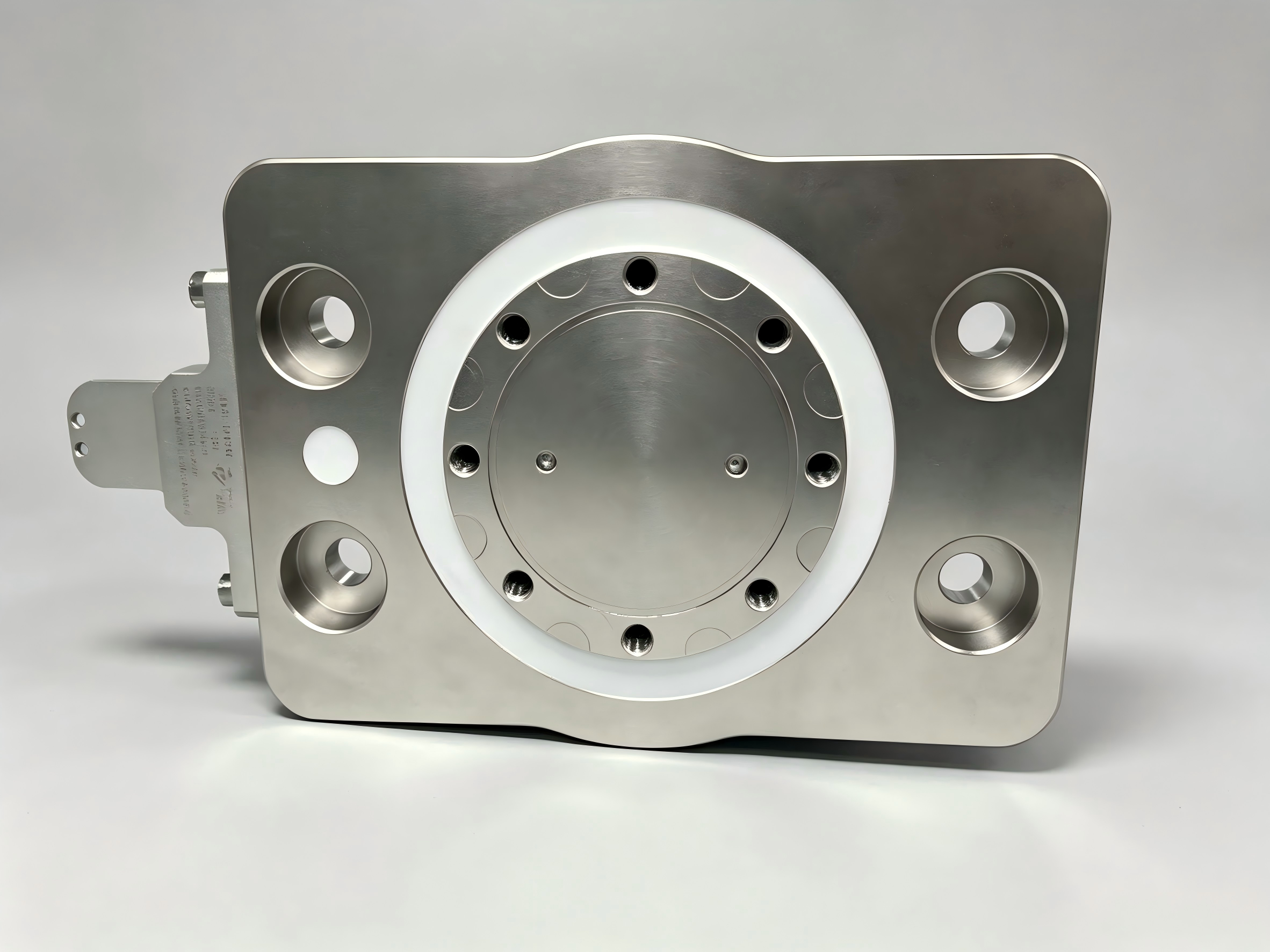
FA9244-25T Heavy-Duty Pressure Sensor Empowering Autonomous Port Transportation
Driven by the rapid advancement of port automation and autonomous driving technologies, smart ports are becoming a key direction for the future of modern logistics and transportation. As one of the core transportation assets in smart ports, autonomous heavy-duty trucks are responsible for critical tasks such as container transfer, terminal logistics transportation, and yard dispatching.
Compared with traditional manually driven vehicles, autonomous trucks rely on the coordinated operation of LiDAR, vision systems, inertial navigation systems, and chassis force sensing systems to achieve autonomous decision-making and precise vehicle control. Among these technologies, the chassis weighing system plays a vital role in monitoring vehicle status, directly affecting load identification, center-of-gravity calculation, braking control, and overall driving safety.
To meet the requirements of smart port autonomous trucks, FIBOS has developed the FA9244-25T Heavy-Duty Pressure Sensor, providing a high-precision and highly reliable force sensing solution for autonomous port vehicles.
Why Do Smart Port Autonomous Trucks Need High-Precision Weighing Systems?
During operation, autonomous heavy-duty trucks must continuously obtain real-time information about vehicle load conditions and chassis force distribution.
These data are widely used for:
· Autonomous driving path planning
· Vehicle attitude control
· Intelligent brake force distribution
· Power output optimization
· Overload monitoring and warning
· Container weight identification
· Vehicle health management
For conventional vehicles, drivers can assess vehicle conditions based on experience. However, autonomous trucks rely entirely on sensor-generated data for decision-making.
Any deviation in load measurement may result in:
· Incorrect center-of-gravity calculations
· Reduced cornering stability
· Increased braking distance
· Accelerated tire wear
· Reduced autonomous driving accuracy
· Increased safety risks
Therefore, accurate and stable weighing sensors have become a critical sensing component in smart port autonomous driving systems.
Typical Challenges Faced by Autonomous Port Trucks
1. Continuous Heavy Loads from Container Transportation
Port transportation vehicles typically handle 20-foot and 40-foot containers.
A fully loaded container can weigh several tens of tons.
Long-term operation under heavy loads places extremely high demands on chassis force measurement systems.
Conventional industrial sensors may experience:
· Increased creep
· Reduced accuracy
· Metal fatigue
· Shortened service life
2. Frequent Dynamic Impact Loads
During daily port operations, activities such as:
· Container lifting and placement
· Rapid acceleration
· Emergency braking
· Uneven road surfaces
· Ramp crossings
can generate significant instantaneous impact loads.
These impact forces are often much higher than static loads.
If a sensor lacks sufficient overload protection, it may suffer from:
· Signal abnormalities
· Data distortion
· Permanent deformation
· Equipment damage
3. Severe Corrosion in Coastal Environments
Ports are typically exposed to high-salt environments.
Long-term exposure to:
· Sea breeze
· Salt spray
· Rainwater
· Dust
· Oil contamination
can cause conventional sensors to experience:
· Housing corrosion
· Seal failure
· Cable aging
· Connector damage
This increases maintenance costs and downtime risks.
4. Temperature Variations Affect Measurement Accuracy
Ports operate around the clock.
High summer temperatures, low winter temperatures, and significant day-night temperature fluctuations can all affect sensor performance.
Without effective temperature compensation, sensors may experience:
· Zero drift
· Sensitivity changes
· Data fluctuations
which can negatively impact autonomous driving decisions.
FA9244-25T Heavy-Duty Pressure Sensor Solution
To address the demanding conditions of smart port operations, FIBOS specifically developed the FA9244-25T Heavy-Duty Pressure Sensor.
The product has been comprehensively optimized in terms of structural design, material selection, sealing technology, and signal stability.
Technical Specifications
| Specifications | Technique |
| Model | FA9244 |
| Product Type | Heavy-Duty Pressure Sensor |
| Accuracy | ≤0.2% F.S. |
| Safe Overload | 120% F.S. |
| Ultimate Overload | 150% F.S. |
| IP | IP65 |
| Operating Temperature | -20°C to 80°C |
| Creep 30min | ≤0.1%F.S. |
| Material | Alloy steel |
| Cable size | Aviation connector/cable, 3 metres |
| Applicable Vehicles | Autonomous Heavy Trucks, AGVs, Port Transport Vehicles |
![Heavy-Duty Pressure Sensor]()
Key Advantages of the FA9244-25T
1. High Capacity Design for Heavy-Duty Transportation
The 25-ton rated capacity is specifically designed to meet the requirements of:
· Container transport trucks
· Autonomous port heavy-duty trucks
· Autonomous logistics vehicles
and other heavy-load applications.
Even under complex road conditions and impact loads, the sensor maintains stable and reliable measurements.
2. High-Precision Measurement for Autonomous Driving
The sensor utilizes advanced strain gauge technology and precision compensation processes.
Comprehensive accuracy is maintained within:
≤0.2% F.S.
This ensures long-term stable and accurate load measurement data.
It enables autonomous driving systems to achieve:
· Accurate center-of-gravity calculations
· Dynamic vehicle attitude control
· Stable route planning
3. Excellent Overload Resistance
The FA9244-25T offers:
· 120% F.S. safe overload protection
· 150% F.S. ultimate overload capacity
Even under severe container placement impacts or rough road conditions, the sensor remains protected and operational.
This significantly reduces the risk of equipment damage.
4. Stable Performance Across Wide Temperature Ranges
With full-range temperature compensation technology, the sensor operates reliably within:
-20°C to 80°C
This effectively minimizes measurement errors caused by environmental temperature changes.
5. Highly Reliable Protection Design
The sensor features:
· High-strength alloy steel construction
· Industrial-grade sealing technology
· IP65 protection rating
It effectively withstands:
· Salt spray corrosion
· Dust intrusion
· Rain exposure
· Long-term vibration and shock
This greatly reduces maintenance frequency and operating costs.
Typical Application Scenarios
Real-Time Chassis Load Monitoring
The sensor continuously collects chassis force data to help autonomous driving systems monitor:
· Vehicle load conditions
· Axle load distribution
· Center-of-gravity position
This improves overall vehicle stability and operational safety.
Container Weight Detection
The system can automatically identify:
· Empty containers
· Fully loaded containers
· Overloaded containers
· Unevenly loaded containers
This enhances transportation safety management within port operations.
Intelligent Braking Control
Based on real-time load changes, the system dynamically adjusts:
· Braking force output
· Driving force distribution
This helps prevent wheel slip and vehicle instability under heavy-load conditions.
Vehicle Health Monitoring
By continuously monitoring long-term chassis force variations, the system enables:
· Frame fatigue analysis
· Suspension health monitoring
· Fault prediction and warning
This supports predictive maintenance strategies for port operators.
FAQ
Q1: What types of vehicles are suitable for the FA9244-25T?
The sensor is suitable for:
· Smart port autonomous heavy-duty trucks
· Autonomous container trucks
· AGV transport vehicles
· Port logistics vehicles
· Heavy-duty transport platforms
Q2: Can the sensor operate long-term in coastal environments?
Yes.
The sensor features a high-strength alloy steel structure and IP65 protection rating, providing excellent resistance to salt spray, humidity, and dust.
Q3: Are customized capacities available?
Yes.
FIBOS can provide customized capacities and mounting structures according to specific project requirements.
Q4: How can the sensor be integrated with autonomous driving systems?
The sensor provides standard industrial signal outputs and can be easily integrated with:
· Autonomous driving controllers
· Drive-by-wire chassis systems
· PLC systems
· Industrial computers
· Vehicle Control Units (VCUs)
Q5: Is the sensor suitable for 24/7 continuous operation?
Yes.
The FA9244-25T is specifically designed for industrial heavy-duty applications and fully supports continuous operation in smart port environments.

 Russia